
Here’s something to ponder. When it comes to buying a used film SLR, is an older, purely mechanical model better than a newer one with an electronic heart? I recently acquired a Nikon F80 that has me leaning more toward the latter than the former.
What precipitated this acquisition? A problem with my vision. Recently, my dominant eye — the one I use for focusing and aiming a camera — developed a cataract bad enough to make photography a real struggle. As a result, for the first time in my life I found myself looking at autofocus SLRs. As I had quite a few autofocus Nikon lenses already, a Nikon camera it was to be.

Being relatively unacquainted with this segment of the camera market, I read quite a few reviews and quickly narrowed the field to just a handful of candidates. Indeed, the end of the line for Nikon autofocus film SLRs really only consists of a few models. There’s the legendary F6, the “prosumer” F100, the mid-range F80, and the entry-level F75 and F55. To be honest, I ended up with the F80 mostly because a clean example turned up at a reputable seller first. But even if fate hadn’t intervened as it did, I still would have gone that way. I not only needed autofocus, I also wanted something lightweight for travel. It was that second consideration that ruled out the otherwise excellent F6 and F100 — the F6 is almost twice the weight of the F80 and even the F100 is us a full 270 grams (9.5 oz) heftier. That’s difference you can definitely feel. And though the F80 may not do everything those other cameras can, it does everything I need it to.
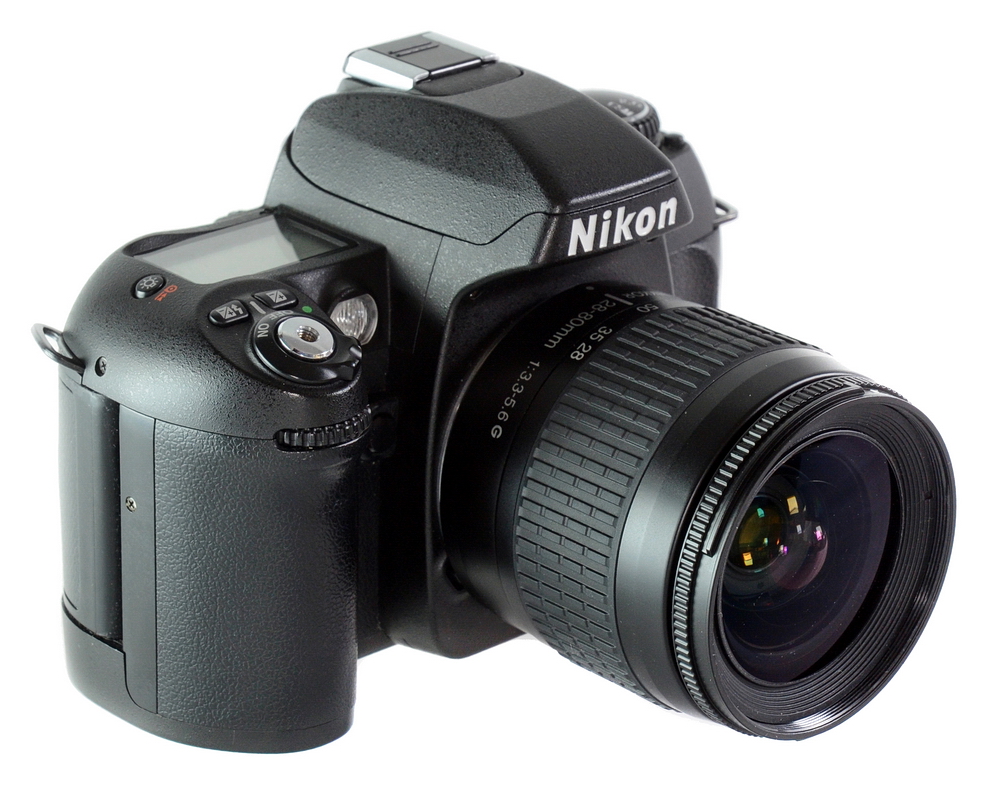
The basics of my F80 review is simply this: It’s a great camera that’s a joy to use. Roll after roll, I got back images that were both correctly exposed and perfectly focused. This really could be a one-and-done camera for a lot of people. For me the F80 also feels great in the hand. It’s neither too bulky, nor too small — it’s just right. Part of the pleasure of using it comes from how gently the shutter release and automatic film-advance mechanisms operate. I don’t know what kind of internal dampening is at work, but there’s very little mirror slap when the shutter is fired. That makes hand-held shots at slow speeds much easier to execute. I also appreciate that the camera works with VR (vibration-reduction) lenses and that many of its features can be activated via the CSM settings. A favourite is the the ability to switch on viewfinder frame lines since I’m crap at keeping my horizons straight without help. (A quick internet search will take you to loads of web sites that go into detail about the camera’s many features so I won’t list them here.) The F80 even has something that the much praised F6 and F100 lack: a standard, thread-in cable release socket. So take that!
What’s not to like? Very little. A lot of the criticisms I encountered during my research tended to focus on the camera’s “plastic” build quality in contrast to the doomsday ruggedness of the F6. It’s true that the F80 is not likely to survive the same level of abuse that its pro-level cousin will, but as a rule I try to avoid abusing my cameras. For me, a far more tangible and useful benefit is the F80’s light weight — and I’m okay with potentially sacrificing some durability to get it. Plus, in my experience, polycarbonate can be very rugged indeed. And there’s little about the F80 that suggests any kind of fragility. The controls feel sure and solid. The one notable exception is the plastic film-door catches, which can break off if care isn’t taken when closing the film door. Fortunately there are inexpensive repair kits readily available on eBay if you find a camera with this problem.
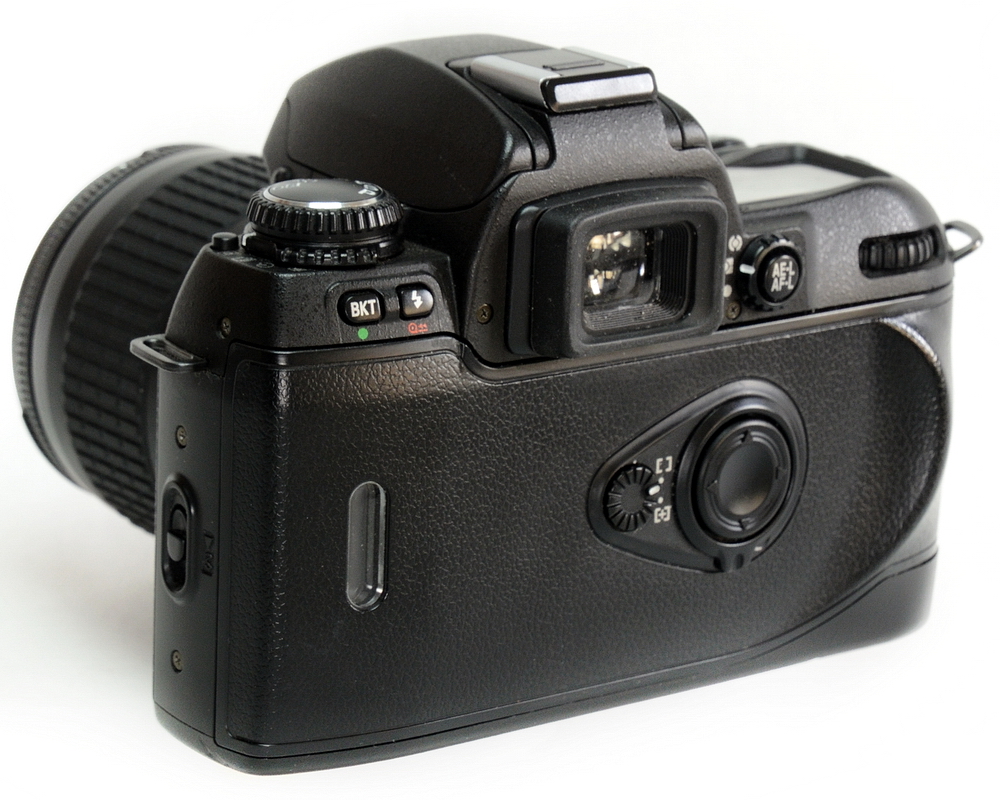
This rear view illustrates the F80’s feature-rich control set, which includes the familiar PSAM mode dial on the top deck and a pop-up flash.
So, let’s return to my initial question. Is a rugged old camera with a lot of miles on it better than a (potentially) more fragile one that has seen very little use? It’s certainly true that a camera reliant on electronics will one day fail whereas a mechanical camera can (at least theoretically) be maintained indefinitely. However, none my cameras have to last forever — they only have to last as long as I do. One day I’m going to “fail,” at which point none of my cameras will be of use to me.
The rise of digital SLRs was well underway by the time the F80 (along with the F6, F75, and F55) ended production. Consider that the Nikon D70 (my first DSLR, and the first for many photographers) appeared in 2004 while the last F80s rolled out in 2006. I’ll bet that quite a few F80s ended up as DSLR place-holders and saw only a couple rolls of film before their owners jumped onto the new and exciting digital bandwagon. Certainly my F80 looks very lightly used. There were no suspect shutter speeds, rotting light seals to replace, stiff controls to battle, or the usual chorus of worrisome rattles that many of my older mechanical cameras arrived with. I was able to use the F80 with confidence right away. And that was, I have to confess, kinda nice.
Click here for some F80 sample images.
Did you find this article interesting or helpful? If so, consider using this link the next time you shop at Amazon.com. Better yet, bookmark it for future use. Thanks to Amazon’s associates program, doing so costs you nothing yet helps keep this site up and running. Thanks!
 Subscribe with RSS







Great article Gary! While I do have a few nice manual focus Nikon film camera, my inexpensive and unloved autofocus cameras from the ’90s, especially the N6006 and N8008, are among my favourites. They meter accurately, are easy to use, and have never let me down. Also, I miss the 1990’s, so there’s that, too.
I miss the vast array of films available in the ’90s, that’s for sure!